

Teenagers spend a lot of their social lives in the digital world, which can make it tough to know when unwanted online contact has crossed from simply being annoying to something more serious.
People who cyberstalk teens might send repeated messages, monitor them all the time, track their location, make threats, or behave in other ways that make a teen feel unsafe or unable to escape.
The emotional impact of cyberstalking can extend beyond the online world and negatively impact sleep, mental health, academic performance, and everyday behavior.[1][2]
Cyberstalking can come from a current or former partner, friend, classmate, or even a stranger. Understanding common warning signs of cyberstalking can help parents intervene early and keep their child safe. This article explores:
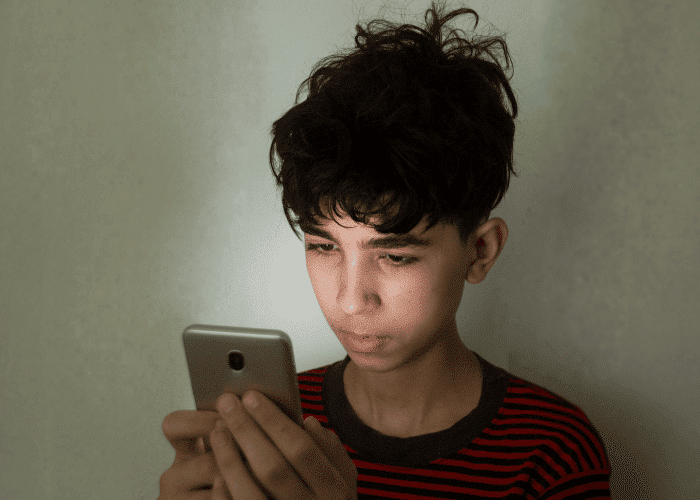
Cyberstalking usually involves a pattern of unwanted behavior that extends beyond one unwanted comment or one unwelcome message.
The Office for Victims of Crime explains that cyberstalking among teens involves the repeated use of technology to contact and harass someone in a way that causes them to fear for their safety.[3] Stalking in a more general sense involves repeated behavior that would cause a person to fear for their safety and experience a great deal of emotional distress.[4]
Examples of online stalking among teenagers include repeatedly engaging in any of these behaviors:
It’s important to remember that cyberstalking is different from ordinary online conflict. Teenagers argue online, and friends send too many messages back to back. But not every uncomfortable online interaction qualifies as cyberstalking. Fear is usually what separates stalking from harassment.
There is a difference between two teens exchanging angry messages after an argument and one teen continuing to message for weeks after being blocked, creating new accounts, and threatening the other teen.
The Stalking Prevention, Awareness, and Resource Center (SPARC) notes that stalking can involve:[5]
This is why it can be important to evaluate the overall pattern, instead of looking at each message individually. One text on its own might seem harmless, but thirty unwanted messages and repeated new accounts tell a different story.
Teens do not always tell parents when online harassment is happening. They might feel embarrassed or worry that their phone will be taken away. Instead, parents might notice changes like:
A teen experiencing cyberstalking anxiety may also start changing their daily routines. They might stop attending activities or ask that friends no longer tag them in photos.
SPARC emphasizes that behavioral changes like screening calls or avoiding locations may be important indicators of fear even when the person does not openly describe themselves as scared.[5] Fear can also look like anger or frustration, so a teen who seems irritated may still be frightened.
Sometimes cyberstalking can occur inside of a dating relationship or a close friendship, and monitoring may be framed as affection or care. But over time, the teen may start to feel like they have to explain every movement.
Online monitoring abuse can include:
Control can be difficult for teens to identify when it is mixed with affection. But healthy relationships and friendships allow for boundaries and time offline.
Cyberstalkers often take advantage of the information that a teen already shares online. Someone may easily learn:
The stalker might not even need access to the teen’s account if friends continue posting photos and locations.
This doesn’t mean that the teen caused the stalking by sharing too much information. The responsibility belongs to the stalker. But privacy changes are one way to increase safety.
Not all digital stalking involves direct contact. Sometimes a person may attempt to control a teenager by damaging their reputation online. They might create fake accounts and pretend to be the teen online, spread rumors, share private messages, or post manipulated screenshots.
This can damage the teen’s reputation and their relationships with friends and peers. If someone is impersonating a child, parents should report it to the social media platform or contact law enforcement.
Cyberstalking and teen mental health are closely connected because online stalking can create a feeling that there is no safe place. Unlike in-person bullying, stalking in the digital world can follow a teen into their bedroom, day or night.
Possible cyberstalking symptoms may include:
Research on cybervictimization also shows associations between online harassment and depression, anxiety, social problems, and even suicidal thoughts and behaviors.[2][6]
If a teen thinks they are being cyberstalked, the immediate priority is their safety. A teen does not have to wait until the cyberstalking gets “bad enough” or reaches a point of physical danger.
A teen also does not need to confront the person who is frightening them. Instead, they can:
SPARC recommends documenting stalking behavior because isolated incidents may not seem like a big deal until they are recorded together and demonstrate a clear pattern.[5] Before deleting messages or accounts, consider whether they may be needed as evidence.
Telling your teen to block someone who is harassing them is often a reasonable step and can be helpful. Again, before you block them, help your teen save evidence, such as messages, calls, and dates. Documenting each incident can help show a pattern and may be useful when reporting the behavior to appropriate authorities.[7]
Blocking the person may limit unwanted contact, but it may not fully solve the problem. Cyberstalking may continue through:
Because stalking behaviors can change or escalate, families should consider the teen’s specific situation when deciding what steps to take next.[7]
A victim-service provider can help the family build a safety plan and explore available options. If the teen is in immediate danger, call 911.[7]
Mission Prep is here to help you or your loved one take the next steps towards an improved mental well-being.

Cyberstalking can reach a point where families need support beyond changing privacy settings and blocking an account. Depending on who is involved and whether there are safety concerns, it may be appropriate to involve the school, law enforcement, or both.
Families do not have to handle online harassment involving teens alone. Stalking is a crime in all 50 states, and the U.S. Department of Justice advises contacting your local police to report stalking or related threats.[8]
Specific stalking laws vary depending on the state, but parents do not need to figure that out on their own. Contacting law enforcement can help provide guidance when assessing:
If someone is in immediate danger, call 911 right away.
School involvement might be an appropriate option when the other person is a student and the behavior:
Parents can share evidence with the school, including screenshots and messages that show the pattern of behavior. You can also directly ask the school how safety concerns will be addressed and who should serve as the main point of contact.
A parent’s reaction can have a big influence on whether a teen continues asking for help. Research involving teens suggests that those who feel supported by their parents may be less affected by cyberstalking.[1]
Parents may immediately want to ask why their teen didn’t block the other person sooner or wonder why their teen shared their location online. But staying calm and listening first can make your child more likely to keep telling you what’s happening. You can then reassure them that they’re not facing this alone and that you will work with them to determine next steps.
A teen might continue to feel the emotional impact of online harassment, even after the harassment stops. Consider professional support when cyberstalking and teen mental health concerns include:
If your teen has thoughts of suicide, call or text 988 to reach the 988 Suicide & Crisis Lifeline, which is open 24/7.
Cyberstalking should not be dismissed as ordinary online drama when a teenager feels unsafe. Protecting their physical and digital safety comes first. Online harassment support can involve a combination of approaches, including therapy and victim advocacy, to help a teen regain a sense of confidence and security.
Mission Prep provides treatment for teens experiencing various mental health conditions. Mental Health support is a phone call away – call 866-901-4047 to learn about your treatment options.
See our residences in Southern California’s Los Angeles & San Diego areas.
Take a look at our Minneapolis-St. Paul area homes in Hennepin County.
View our facilities in Loudoun County, VA within the DC metro area.
Cyberstalking can affect much more than just a teen’s social media experience. Repeated monitoring, unwanted contact, threats, and other types of digital harassment can contribute to mental health symptoms like anxiety and depression.
At Mission Prep Teen Treatment, we treat teens ages 12 to 17 who are dealing with mental health concerns, including trauma, PTSD, stress, or life changes. When a teen’s symptoms continue after the immediate safety issue has been dealt with, treatment can help them manage their emotions and build coping skills.
We offer tailored treatment programs that incorporate evidence-based therapeutic approaches and innovative interventions to foster sustainable change for adolescents and their families. Whether your teen could benefit from residential treatment at one of our locations or something more flexible, like an outpatient mental health program delivered virtually, our team can help.
Mission Prep Teen Treatment accepts insurance and is in-network with most major providers. We are happy to help you check your insurance coverage for mental health care.
Learn about our admissions process online or call 866-901-4047 to speak with a caring member of our team who can answer any questions you might have. Reach out for a free, no-obligation conversation.
"*" indicates required fields
🔒 100% Confidential
No Commitment
✓ Instant Results
Are You Covered for Mental Health Treatment?
We’re in-network with many providers. Call us at 866-901-4047 to verify your benefits and find out how much your plan will cover









Find out if Mission Prep is right for you by reaching out to us and speaking with one of our admissions representatives.