

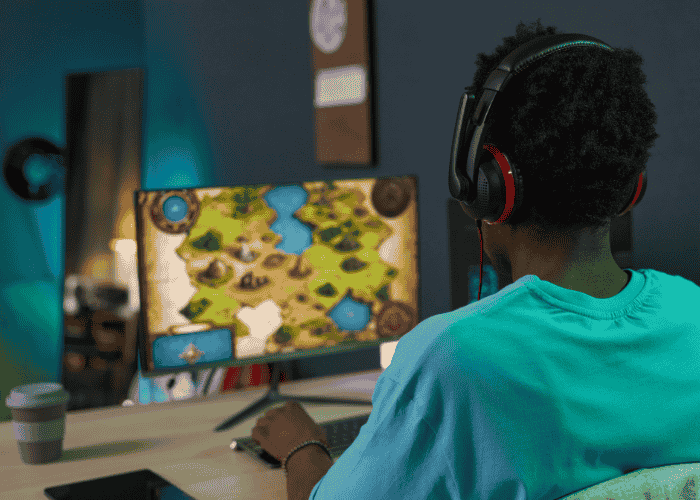
A teen sits down to play “just one more game.” But an hour later, they’re still there, not entirely sure how that happened. Biology has a lot to do with the link between video games, dopamine, and teenage brain development. This link can help explain why games can feel so hard for adolescents to stop playing.
The teenage brain’s reward system, the same one that makes food and friendship feel good, activates every time a player levels up, loots a rare item, clears a stage, or narrowly dodges a game-over screen.[1] Understanding that process can help teens make more informed choices about how they play and when it’s time to put the controller down. This article will explore:
Dopamine is often called the feel-good chemical, but that really undersells its function. Dopamine works more like a motivation chemical than a pleasure one, driving people to pursue something rewarding.[2] It also helps the brain decide what is important or beneficial (though it may not actually be), and teaches the brain what to chase next.
This system evolved to keep humans doing the things that matter for survival, like:[2]
But dopamine doesn’t know the difference between finding food or unlocking a video game achievement. It responds to whether something turns out better than expected and whether it’s worth paying attention to.[2]
That’s part of why an outcome a player didn’t see coming can feel more exciting than one predicted from the start. In simple terms, dopamine makes the brain more sensitive to unpredictability than to the actual reward.
Dopamine functions like the brain’s note-taking system. Each win, like a leveled-up character or a new skin unlocked, strengthens the connection between action and reward. It’s the same wiring behind why acing a hard test can make a student want to study that subject again, or why a sport gets easier to stick with once a player starts winning.
It’s a system that keeps maturing well past the teen years, so the pull of a rewarding activity can feel different at 15 than it will at 25.[2] Game designers understand this reward-and-repetition loop extremely well, and have spent decades refining it.
Researchers using brain imaging have found that playing video games lights up the ventral striatum, a key hub in the dopamine reward pathway, and the activity tracks closely with how well the game is going.[1] In one study of 14-year-olds, frequent players even showed structural differences in this brain region compared with occasional players. That’s a sign of just how responsive this circuitry is to repeated play.[1]
Part of what makes games so effective at holding a player’s attention is how often they hand the brain a clear sign of measurable progress. Each victory is a small, concrete win that gives that circuitry another reason to fire.[1]
Randomized rewards, like loot boxes and card packs, are most effective because rewards a player can’t predict are what the system responds to most of all.
Stanford Medicine runs a clinic for young people with addictions, led by a child and adolescent psychiatrist. Its reporting on that work explains that today’s games are “becoming better and better at supplying pings of dopamine” compared with the simpler games earlier generations grew up with.[3]
Huge multiplayer worlds with complex, ongoing storylines and sophisticated sounds and graphics are part of that change. Each gives a teen’s reward pathway far more chances to fire than a single-player game someone could finish and set down for good.[3]
That’s a deliberate design choice, one that reflects a real understanding of how dopamine and reward learning work. Knowing this before picking up a controller helps just like it helps to know how advertising works before scrolling past an ad on a phone. It makes it easier for teens to notice when gaming stops feeling like their own choice.
Here’s where the science gets personal. A teen’s prefrontal cortex, the part of the brain that handles planning and impulse control, including weighing “one more game” against “needing to be up early,” is one of the last brain regions to mature. In fact, it usually keeps developing into a person’s twenties.[4]
Meanwhile, the deeper (subcortical) reward circuitry that responds to dopamine develops earlier. That leaves the teen brain out of balance for a while. The reward system matures fast, and the system for holding back matures slowly.[4]
That gap is normal, and it isn’t unique to gaming. It helps explain why the teen years are also a period of rapid learning and a drive to try new things, take social risks, push limits, and seek out novelty.[4] But it also means the pull toward “just five more minutes” can hit harder now than it will once your prefrontal cortex catches up.[4]
One study followed thousands of adolescents over several years and looked at how a teen’s brain responded while waiting for a reward. Teens whose brains showed a weaker response while waiting tended to report more symptoms of compulsive gaming as they got older.[5]
This suggests reward processing helps decide who finds adolescent gaming harder to control.[5] Willpower and free time play their part too, but it can help to remember the reward-processing piece the next time stopping should feel harder than it should.

Mission Prep is here to help you or your loved one take the next steps towards an improved mental well-being.
Most gaming, even a lot of it, is just gaming, and it stimulates a brain that is just doing what brains do. But there’s also a recognized mental health condition where gaming has become problematic. It is sometimes called gaming addiction, gaming disorder, or video game addiction, depending on which health organization you ask.
Health bodies that classify gaming disorder describe a pattern where:
For a formal diagnosis, this pattern typically needs to hold for about a year.[6]
The number of hours on the clock only tells part of the story. Two people can play the same hours each week and end up in very different places. One is having fun on a schedule that works for their life, while the other has watched gaming quietly take over their sleep, grades, and friendships.
That second pattern is the one to act on.[6] Catching the pattern early, while small adjustments still feel manageable, tends to make the biggest difference.
Pediatric health experts no longer talk about digital health in terms of strict hour limits anymore. They ask a more useful question: Is screen time getting in the way of sleep, schoolwork, exercise, or time with loved ones?[7] Research points to a few habits that support healthier screen time and gaming patterns:
The adults in a teen’s life have a part in this too. Two separate studies looked at how parents handle screens. Teens whose caregivers monitored and set limits around gaming, instead of using screens for rewards or punishments, showed lower rates of problematic use over time.[8][9]
Mission Prep provides treatment for teens experiencing various mental health conditions. Mental Health support is a phone call away – call 866-901-4047 to learn about your treatment options.
See our residences in Southern California’s Los Angeles & San Diego areas.
Take a look at our Minneapolis-St. Paul area homes in Hennepin County.
View our facilities in Loudoun County, VA within the DC metro area.
If any of the patterns described here hit closer to home than expected, it shouldn’t be brushed off. Noticing that something isn’t right is usually the hardest part, and what comes next is often more manageable than it seems.
Treatment for compulsive gaming works, and it may not mean giving up gaming forever. A recent review of therapeutic approaches for gaming-related conditions found that structured, evidence-based support like cognitive behavioral therapy reliably reduces symptoms as well as anxiety and low mood that often come with it.[10] Getting support early helps make things easier and prevents issues from escalating.
At Mission Prep Teen Treatment, we offer a variety of treatment programs and therapy services, with individualized care built around what they need. That means real support for whatever is underneath the gaming, be that isolation, something being avoided, or something else that hasn’t quite been identified yet. We help develop a plan shaped around each teen’s life.
Whether your teen could benefit from residential treatment at one of our locations or something more flexible, like an outpatient mental health program delivered virtually, our team can help. Mission Prep Teen Treatment accepts insurance and is in-network with most major providers. We are happy to help you check your insurance coverage for mental health care.
Start the admissions process online or call 866-901-4047 to speak with a caring member of our team who can answer any questions you might have. Reach out for a free, no-obligation conversation.
"*" indicates required fields
🔒 100% Confidential
No Commitment
✓ Instant Results
Are You Covered for Mental Health Treatment?
We’re in-network with many providers. Call us at 866-901-4047 to verify your benefits and find out how much your plan will cover









Find out if Mission Prep is right for you by reaching out to us and speaking with one of our admissions representatives.