

As a parent, it might seem a little strange or even worrying when your teen spends hours a day in an online world you don’t fully understand. That feeling may grow when they talk about rankings like school grades or describe people they’ve never met in person as close friends.
If you’re not a gamer yourself, it can seem like a lot of time spent in front of a screen. But the gaming identity teens build can become a big part of who they are, and understanding it can help you recognize when your teen might need support.
To help you, this page will cover:
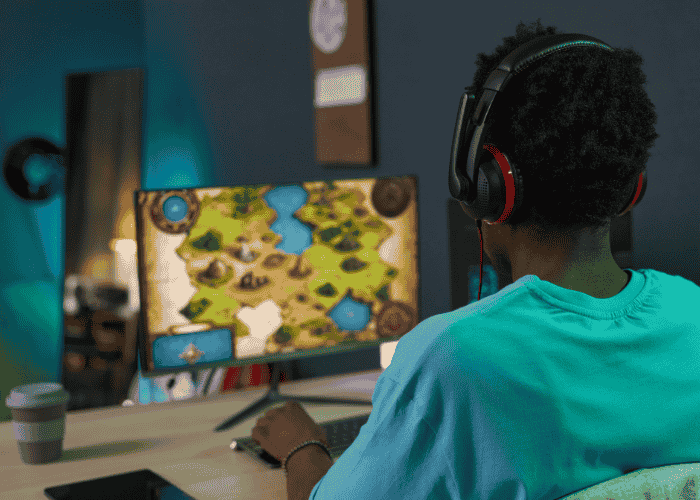
Video games are part of everyday life for many U.S. teens. National surveys show that 85% of teens aged 13-17 said they played video games, with 40% playing every day.[1]
The gaming identity teens develop reflects how they see themselves through the games they play and the people they play with. For some teens, a gaming identity can have a lot of influence on who their friends are.
One of the first attempts to make sense of gaming and online identity came from game researcher Richard Bartle, who, in 1996, noticed four types of players in early text-based online games.[2]
These were:
This model was built to help people design games, but each type says something about why a person plays and how they behave in their online life. Games have come a long way since then, but these types can still be a useful starting point for understanding your teen.
If they mostly talk about unlocking rewards or completing the game, they may lean toward being an achiever. If they spend most of their time chatting with friends through a headset, they may be more of a socializer.
These player types offer clues about motivation, but they don’t capture everything gaming means to your teen. Their identity may also involve their character, reputation, and friendships within a game.
A modern video game identity is made up of several parts, and each may show up in how your teen talks, plays, and connects with others. Understanding these parts can help you see why gaming matters so much to your teen.
An avatar is the character your teen plays as, and many games let players change almost everything about how it looks. Some teens may heavily customize their avatar so that it can become an idealized version of themselves, and a big part of the virtual identity teens show to other players.[3]
Some research suggests that people can act in line with how their avatar looks, which is known as the Proteus effect.[4]
If your teen enjoys customizing their avatars, you might notice them doing things like:
In competitive games, a player’s rank and stats are often on show for everyone to see. Among teens who identify as gamers, 43% say competing against others is a major reason they play.[1]
A high rank can bring respect from other players, which is why you might notice your teen playing for hours to climb up in the rankings, or getting frustrated when they lose.
These are normal parts of competitive gaming, but they can tip into a problem depending on how your teen feels about their rank. Researchers state there are two ways of being passionate about a game:[5]
The study found that obsessive passion was much higher among those with problematic gaming.[5]
Gaming can be a social activity for teens, with a national survey finding that 89% of teens who play games do so with other people.[1] Many of the gaming communities teens join feature live conversations with other players on apps like Discord, which 44% of teen gamers use.[1]
Online gaming friendships might seem strange to you as a parent, but for teens, it’s a big deal, with almost half who play games noting they’ve made a friend online through a game.[1]
Many media reports on gaming mental health are quick to reel off the negative side of teen gaming, and while they certainly exist, gaming can have a positive effect on teens. A review found that gaming can benefit teens’ thinking skills and emotional well-being, as well as their social lives.[6]
When Pew Research Center asked teen players how gaming affected their lives, they found that: [1]
While not all teens agreed with this, very few stated that gaming had hurt these areas of their lives.[1]
Gaming can give teens a place where they feel they fit in, especially for those who have difficulties connecting with others at school. Research on online spaces more broadly found that many LGBTQ+ young people said they go online to connect with others because it’s hard to do in their daily lives.[7]
Autistic teens can also find something positive in gaming. One study found that autistic teen boys described gaming as something they could control on their own terms, without someone watching them.[8]
Games use failure to keep players motivated, with big wins coming only occasionally.[9] This kind of unpredictable reward is one of the most effective ways to learn a new behavior, and researchers believe it teaches players that sticking with something difficult pays off.[9]
That lesson connects to how your teen feels about themselves when things go wrong. People who see ability and intelligence as fixed can feel worthless after a failure, but those who see it as built through effort take failure as a cue to keep going.[9]
This outlook is linked with better results at school, which suggests that games may encourage persistence by giving players opportunities to try again after setbacks.[9]
However, persistence in a game doesn’t necessarily translate into greater confidence elsewhere. The relationship between gaming and self-esteem is more complicated than simply winning, losing, or learning to keep trying.[9]

Mission Prep is here to help you or your loved one take the next steps towards an improved mental well-being.
Of course, all these points stand as long as there’s a healthy balance. If the balance starts to tip into the negative, pay attention when gaming repeatedly takes priority over:
Gaming can give teens a real sense of achievement when it’s part of a balanced life. But for a teen who already feels low, the game can become the only place they feel good. In fact, low self-esteem is a known risk factor for problem gaming, and a review found this link across different cultures and age groups.[10]
Avatars can actually play a role in this too, with research suggesting that some people with gaming disorder identify very strongly with an idealized version of themselves in-game.[3] The more a teen leans on this idealized self, the worse they may feel about how they see themselves offline.[4]
Frequent late-night gaming can cut into the sleep teens need, with 41% of teens who play games saying gaming has hurt their sleep in the past.[1] This rises to 48% among teens who identify as gamers, so the more central gaming is to their identity, the bigger the impact can be.[1]
This has implications for their mental health, as teens who don’t get enough sleep have a higher risk of poor mental health and problems with attention and behavior.[11]
The social side of online gaming culture isn’t always positive, and it can be hard for your teen to avoid it. Around three-quarters of U.S. 10- to 17-year-olds said they were harassed while playing online multiplayer games, with 37% facing harassment because of their identity.[12]
If your teen’s friendships and sense of belonging are tied up in their gaming identity, harassment can mean they have to walk away from it. Players have reported that they may respond to online bullying by muting themselves on voice chat or switching to offline games, with some choosing to leave games altogether.[12]
For a teen whose social life is based on a specific game, being pushed out of it can mean losing an important source of connection. This can take a big toll on their mental health, with reviews showing that being bullied online was linked with later symptoms of depression and anxiety.[13]
The gaming identity teens build is not necessarily a problem; what matters is whether gaming is disrupting their health, relationships, or daily responsibilities. If you feel your teen’s gaming identity has started to take over the rest of their life, try to monitor signs like:
These signs alone do not establish a mental health condition. Seek professional advice if gaming is persistently disrupting your teen’s sleep, schoolwork, relationships, or daily responsibilities.[14]
Mission Prep provides treatment for teens experiencing various mental health conditions. Mental Health support is a phone call away – call 866-901-4047 to learn about your treatment options.
See our residences in Southern California’s Los Angeles & San Diego areas.
Take a look at our Minneapolis-St. Paul area homes in Hennepin County.
View our facilities in Loudoun County, VA within the DC metro area.
At Mission Prep Teen Treatment, we offer personalized mental health treatment programs for teens ages 12 to 17. We start with a clinical assessment to establish if there’s anything behind the problem gaming signs they show. Our expert team can support them with technology dependence, should they need it, as well as conditions like anxiety and depression.
Whether your teen could benefit from residential treatment at one of our locations or something more flexible, like an outpatient mental health program delivered virtually, our team can help. Mission Prep Teen Treatment accepts insurance and is in-network with most major providers. We are happy to help you check your insurance coverage for mental health care.
Learn about our admissions process online or call 866-901-4047 to speak with a caring member of our team who can answer any questions you might have. Reach out for a free, no-obligation conversation.
"*" indicates required fields
🔒 100% Confidential
No Commitment
✓ Instant Results
Are You Covered for Mental Health Treatment?
We’re in-network with many providers. Call us at 866-901-4047 to verify your benefits and find out how much your plan will cover









Find out if Mission Prep is right for you by reaching out to us and speaking with one of our admissions representatives.