

Games are supposed to be fun, but some matches leave you more annoyed than when you started. Maybe you’ve caught yourself yelling at teammates, or a parent has asked why you’re so angry after playing.
Many teens experience frustration when gaming, and understanding where it comes from can make it a lot easier to keep your cool. However, in some cases, it can be a sign that other emotional difficulties may be causing the rage you’re feeling.
With this in mind, this page aims to provide information on video game anger for both parents and teens by covering the following topics:
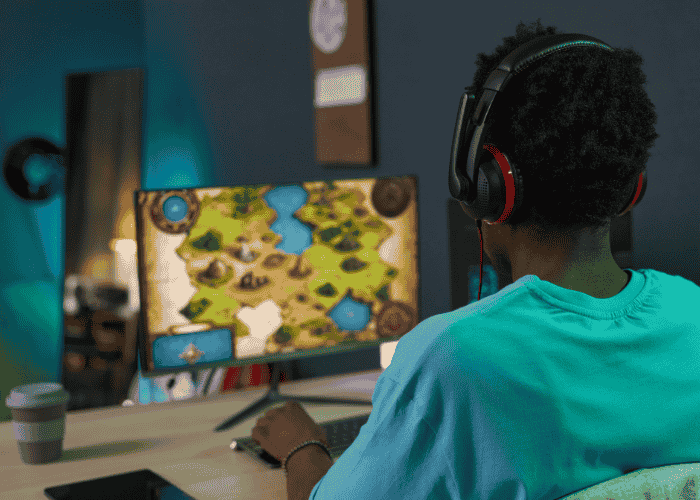
Let’s set the scene: you’ve had a pretty poor gaming session and haven’t been able to get a win in hours. After a while, you notice it’s the same player who’s constantly beating you, the same name that flashes up on the screen every time you go down.
You can feel the anger start to build, and no matter what you do, you just can’t seem to beat them. You see them on screen from a distance, you’ve got them right where you want them, and then… they turn around quicker than you and send you back to the respawn point.
Start button, pause menu, leave game. Perhaps a controller that finds its way halfway across the room?
It’s a common experience, so much so that gamers even have a name for it: rage-quitting.[1] Getting angry at a game doesn’t mean there’s something wrong with you. Frustration can often be a common part of gaming. But it can help to understand where the anger comes from, as it can be the first step in handling it.
Researchers have found that gaming frustration comes from struggling with a game’s controls or difficulty.[1] In a series of six studies, games that got in the way of players’ sense of skill led to more aggressive feelings and thoughts.[1]
That’s why things like internet lag or getting used to a new game’s controls can cause so much video game anger. When the outcome feels out of your hands, frustration can build fast.
Ranked matches, where results affect your overall online score, can also be another area of gaming stress. One study found that heart rate and blood pressure rose more during competitive games against human players than in casual ones against computer opponents.[2]
Other players can make it worse, too, with one survey finding that 60% of 13- to 17-year-olds reported being harassed while playing online multiplayer games.[3] A stranger’s trash talk can make an already frustrating situation feel much worse. In fact, over a quarter of young gamers who were harassed ended up quitting specific games because of it.[3]
Gamer rage can also happen because of your age. Your brain is still developing, and the part that controls decision-making and handling emotions, called the prefrontal cortex, is still under construction.[4] This contributes to why it can feel difficult to deal with losses and may even be a reason why you experience gamer rage.
On a good day, a loss might hardly register, but on a bad one, even a small mistake can set you off. The game isn’t always the reason.
Research has found that teens who only manage around 6.5 hours of sleep a night struggle to manage their emotions compared to those who get 10 hours.[5] If you’re gaming while sleep-deprived, you might notice it’s a little harder to control your emotions when things don’t go right.
When you’re deep into a long gaming stretch, it’s easy to grab whatever’s quickest, like chips or energy drinks. But one review found that eating more junk food was linked with higher odds of stress and depression in adults.[6]
Junk food once in a while isn’t necessarily a concern, but if you’re combining frequent gaming with a frequent poor diet, it could be what’s behind gaming rage in teens.
Going over a loss again and again can keep the anger alive long after you log off. One study found that young people who dwelled on angry thoughts reported greater irritability when they followed up with them six months later.[7] This might be why anger after gaming can feel as though it follows you into the rest of your evening.
If you’ve noticed a lot of anger while you’re playing video games, it can be reassuring to know that gaming emotional regulation is a skill you can build. Even though your brain is still developing, it has an amazing ability to adapt to new experiences. Here are some moves that could help you:
Anger usually builds before it boils over, and knowing your triggers can stop them from tipping your emotions over the edge.
You might notice signs like:[8]
Once you know your own signs, you can hit the pause button and take a moment to relax before the rage takes over.
It might sound strange, but putting a feeling into words can really help with calming down. Research suggests that naming an emotion may take some of the sting out of it.[9]
For example, you could try saying the words “I’m frustrated because I keep losing” out loud, followed by slow and controlled breathing.
Advice suggests that breathing from your stomach instead of from your chest can help reduce feelings of anger, so it’s worth trying when you’re experiencing gaming rage symptoms.[10]
Instead of jumping straight into another match when you’re feeling pent up, give yourself a short break. Use that break to check what you need: water, food, rest, or simply time away from the screen.
Even a few minutes away from your digital life can help you come back calmer, but if the rage feels stronger than normal, try a little physical activity. Moving your body releases chemicals called endorphins that can help lift a bad mood.
Where you game is your own personal space, and if other players online are the problem, you don’t have to let them in. Use the mute button on specific players or, if it becomes too much, block them from playing with you.
You can even consider turning off voice chat for strangers entirely, meaning only people you’re friends with can communicate with you. Protecting your mental health and your identity online is important when you’re frequently playing online games.

Mission Prep is here to help you or your loved one take the next steps towards an improved mental well-being.
Everyone gets frustrated with gaming from time to time, but if the anger doesn’t switch off when the console does, it could be a sign that something else is going on.
It may be worth talking to someone if you notice:[11]
These signs look a little different for everyone, but if you notice some of these, it’s worth talking with a parent or someone else you can trust. They’ll be able to help you figure out what’s going on and find a way to deal with it.
Hearing yelling from your teen’s room mid-game can be unsettling, but the occasional shout at a screen is a part of gaming for a lot of teens. In many cases, gaming rage in teens is a reaction to frustration that passes once the game is over.
It may be time to look for extra support if you’ve noticed:[12][13]
These changes don’t always mean something serious is going on, but they’re worth talking through with professionals who work with teen emotions.
Mission Prep provides treatment for teens experiencing various mental health conditions. Mental Health support is a phone call away – call 866-901-4047 to learn about your treatment options.
See our residences in Southern California’s Los Angeles & San Diego areas.
Take a look at our Minneapolis-St. Paul area homes in Hennepin County.
View our facilities in Loudoun County, VA within the DC metro area.
At Mission Prep, we help teens get to the root of what’s driving their anger, which could be the gaming itself or something underneath it. Our team builds individualized care plans around each teen’s life, with support for mental health conditions such as:
We offer tailored treatment programs to suit the needs of your teen, including residential treatment at our locations and virtual intensive outpatient programs (IOP). Our expert clinicians incorporate evidence-based therapeutic approaches like cognitive behavioral therapy (CBT), which can help ease the tense emotions your teen is feeling.
Mission Prep Teen Treatment accepts insurance and is in-network with most major providers. We are happy to help you check your insurance coverage for mental health care.
Learn about our admissions process or call 866-901-4047 to speak with a caring member of our team who can answer any questions you might have. Reach out for a free, no-obligation conversation.
"*" indicates required fields
🔒 100% Confidential
No Commitment
✓ Instant Results
Are You Covered for Mental Health Treatment?
We’re in-network with many providers. Call us at 866-901-4047 to verify your benefits and find out how much your plan will cover









Find out if Mission Prep is right for you by reaching out to us and speaking with one of our admissions representatives.