


Key Takeaways
- Executive functioning includes skills like working memory, inhibitory control, and cognitive flexibility that students rely on to start, organize, and finish schoolwork.
- The 8 strategies start by observing the student mid-task and asking what feels hardest, which pinpoints whether the student needs support with initiation, working memory, planning, or organization.
- Predictable routines, numbered visible instructions, backward planning from a finished product, and simple storage systems cut the mental load that competes with learning.
- Teaching coping routines before overwhelm hits, adding self-check prompts before, during, and after tasks, and slowly reducing adult prompting help students use strategies independently.
- At Mission Prep, we pair a comprehensive assessment with therapy, family involvement, and academic support for teens aged 12 to 17 whose executive functioning struggles go beyond classroom strategies.
What Does Executive Dysfunction Look Like in Students?
Executive dysfunction in students looks like a gap between what they know and what they can actually produce, and helping them starts with spotting which skill is behind that gap. A student might understand a math problem but forget the steps halfway through, or finish homework that never makes it to the teacher.
Other signs show up across the school day. Some students can’t start independent work, forget to write down assignments, or stall during transitions because switching tasks means recalling a new set of expectations. Others shut down under stress, even when they can use a planner or checklist without trouble on a calmer day.
These patterns are easy to mistake for laziness or carelessness, which is why they often go unaddressed. A student who keeps getting feedback that doesn’t match the real obstacle may stop trying altogether, so naming the specific breakdown is the first step toward the right support.
8 Strategies to Help Students with Executive Functioning
1. Identify the Specific Skill or Task That Needs Support
“Improve executive functioning” is too vague to act on. A more useful starting point is an observable problem: a student cannot begin independent work, consistently forgets to record assignments, loses organized research notes, or finishes homework but never turns it in.
Watching the student during the task, rather than only reviewing the finished product, reveals where the breakdown actually occurs. Asking the student directly which part feels hardest often uncovers details an observer would miss.
Once you choose a priority, define a clear, observable behavior that counts as progress. A student who cannot start needs help with task initiation, while a student who loses finished work needs a reliable submission system. These require different fixes.

2. Establish Predictable Routines & Prepare for Transitions
Consistent routines reduce the planning and remembering required for recurring activities, freeing up mental energy for the academic task. Transitions deserve special attention, since switching activities forces a student to disengage from one task, recall the next expectation, and organize a new action all at once.
A daily agenda posted in a consistent location, rehearsed routines for starting class, checking the online class portal, and packing up, plus advance notice before an activity ends, all reduce the number of decisions a student has to make on the fly.
When a schedule changes unexpectedly, explain the change and name the next step to keep the disruption from becoming bigger than it needs to be. A posted routine alone will not do the job; it has to be modeled and practiced until the student can follow it without prompting.
3. Make Instructions Visible & Reduce Working-Memory Demands
Spoken instructions disappear as soon as they’re delivered, and a student can lose track of the sequence while still gathering materials for step one. Written directions, visual cues, and worked examples give students something to refer back to instead of holding every detail in working memory.
Pairing verbal instructions with a short written or visual sequence, numbering steps in order, and keeping directions accessible throughout the activity all reduce this load directly. A checklist that grows too long or crowded becomes its own obstacle, so the goal is a tool that is genuinely easier to use than no tool at all, not simply a longer document.

4. Teach Planning & Time Management Explicitly
Handing a student a planner does not mean they know how to use it. Most students need direct instruction in recording assignments accurately, recognizing deadlines, estimating how long work will actually take, and deciding when each stage should happen.
Planning backward from a finished product helps make this concrete: start by showing what a completed assignment looks like, then work backward to identify the steps, materials, and time required to get there.
A timer should make time easier to understand, not signal pressure to rush. It also helps to account for the entire assignment rather than just the visible output. A history research paper, for example, requires as much time for reading and note-taking as for writing, and skipping that step in the plan sets a student up to run out of time later.
5. Create Simple Organizational Systems & Workspaces
Students lose real time and attention searching for materials, sorting through scattered papers, or getting pulled off task by nearby distractions.
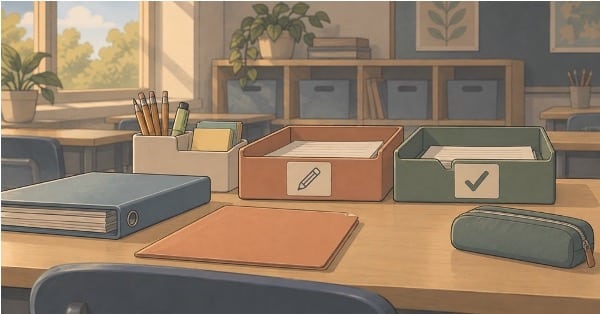
A consistent storage location for supplies and assignments, paired with a workspace with fewer unrelated items in view, removes demands unrelated to the academic task. Clearly separating “work to complete” from “work to submit” also prevents the common scenario where a finished assignment never makes it to the teacher.
The system itself needs to match what the student can actually maintain. A complicated setup with many folders, categories, or apps can create more organizational work than it solves, defeating the purpose.
6. Support Emotional Regulation & Flexible Thinking
Stress and overwhelm interfere with executive functioning, so a distressed student may struggle to use planning or attention strategies that are completely accessible to them when calm. An adult helping a student return to a manageable emotional state, sometimes called co-regulation, creates the conditions needed before any academic strategy can actually work.
Teaching coping routines before a crisis occurs, rather than only responding once a student is already overwhelmed, makes those routines far more usable in the moment.
Alongside emotional support, students need practice adjusting their approach when a task or situation shifts unexpectedly. Acknowledging frustration without shaming the student, reducing the immediate demand to one manageable next action, and revisiting the broader plan once the student can engage again all keep the moment from spiraling.
7. Teach Students to Monitor & Evaluate Their Own Work
Students need a concrete way to notice whether they are following their plan and whether their current strategy is actually helping. Brief prompts before, during, and after a task build this habit into the routine rather than leaving it to chance.
- Before starting: What is my goal, and what is my first step?
- During the task: Am I following my plan, and what could help me continue if I’m stuck?
- Afterward: Did I meet the requirements, and what should I change next time?
Replacing a vague “check your work” with a short checklist tied to the specific assignment keeps the reflection focused on the relationship between the strategy used and the result produced, rather than simply whether the student worked hard.
8. Build Independence Through Modeling, Feedback & Gradual Release
Planning, prioritizing, and self-checking happen almost invisibly in an experienced learner’s mind, which is exactly why a think-aloud is so useful. Demonstrating a strategy during a real classroom task helps make an invisible process visible. It also helps to explain out loud why a particular step was chosen and show how to recognize and revise an approach that isn’t working.
Practicing together before expecting independent use, then giving specific feedback on the strategy itself, builds the skill in the setting where the student actually needs it.
Planners, checklists, and visual reminders can stay in place even after a student shows progress. From there, offer a few workable choices, explain what problem each support solves, and gradually reduce adult prompting as the student uses the strategy more reliably on their own.
Executive Functioning Strategies for Students: Summary Table
| Strategy | Practical Approach |
| Identify specific needs | Observe difficulties, ask students what feels hardest, and define measurable progress. |
| Establish routines and transitions | Rehearse routines, display agendas, and provide advance notice of changes. |
| Make instructions visible | Use short, numbered directions, visual cues, and accessible checklists. |
| Teach planning and time management | Model planner use, work backward from deadlines, and estimate each stage. |
| Simplify organization and workspaces | Assign consistent storage locations, separate unfinished and completed work, and reduce distractions. |
| Support emotional regulation and flexibility | Teach coping routines, acknowledge frustration, and practice adapting approaches. |
| Teach self-monitoring | Use before, during, and after prompts to check progress and results. |
| Build independence gradually | Model strategies, practice together, provide feedback, and reduce adult prompting. |
When Classroom Strategies Aren’t Enough, Mission Prep Steps In
Classroom strategies work best when they match a student’s specific gap, are applied consistently, and are adjusted based on what helps. Some students need more individualized support, especially when executive functioning challenges overlap with anxiety, motivation, or a learning difference. In those cases, a professional evaluation can clarify the cause of the struggle.
At Mission Prep, we start by understanding what’s behind a teen’s challenges. Our programs pair evidence-based therapies like Cognitive Behavioral Therapy (CBT) and Dialectical Behavior Therapy (DBT) with family involvement and educational support, so teens can keep progressing academically during treatment. We also build structured transition plans to help teens return to school with the skills and support they need. If a student’s executive functioning struggles go beyond what the classroom can address, reach out to our admissions team to explore next steps.
Frequently Asked Questions (FAQs)
What is the difference between ADHD and executive functioning challenges?
ADHD is a diagnosable condition, while executive functioning challenges describe a set of skills, such as working memory and inhibitory control, that can be weak with or without an ADHD diagnosis. Many students with ADHD show executive functioning difficulties, but a student can also struggle with planning or organization without meeting criteria for ADHD. Skills-based approaches, such as explicit strategy instruction and therapies like CBT, can help strengthen these skills either way.
How can I support executive functioning in my students in the classroom?
Start by identifying one specific, observable problem rather than trying to address executive functioning broadly. Pair that problem with a matched support, such as a visible checklist for a student who loses track of steps, or a backward-mapped timeline for a student who struggles to plan long-term projects. Track whether the support actually reduces the difficulty before adding more.
Can executive functioning skills improve with age?
Yes, executive functioning skills develop over time, and explicit teaching combined with repeated practice supports that growth. However, improvement on a single training exercise does not automatically transfer to every schoolwork task, so measure progress against the specific classroom behaviors that mattered in the first place.
How do I know if my teen needs an executive functioning evaluation?
Consider an evaluation if your teen consistently struggles to begin tasks, organize materials, or complete assignments despite understanding the content and receiving support at school. A persistent gap between what your teen knows and what they can produce independently, especially at both home and school, is a signal to talk with their school psychologist, pediatrician, or a mental health professional.
Does Mission Prep offer support for students with executive functioning difficulties?
At Mission Prep, we treat teens aged 12 to 17 for a range of concerns, including ADHD and academic and social challenges, which can involve executive functioning difficulties. Care is available through residential, outpatient, and virtual programs to support teens at different stages of their recovery.