

Social media is a large part of many teens’ daily lives. From messaging friends to sharing milestones and following trends, online spaces shape how adolescents connect, express themselves, and understand the world around them. So it’s understandable that conversations about teen mental health and social media have become more common in recent years – and for good reasons.
While social media can encourage self-expression and offer a sense of belonging, it can also contribute to stress, comparison, sleep disruption, and emotional overload. Social media platforms are designed to keep users engaged, and with nearly nine in ten teens using social media daily, stepping away may feel difficult.1,2
In this blog, we’ll explore how social media affects adolescent mental health and outline nine social media boundaries for teens that can help protect their emotional well-being.
How Does Social Media Affect Teen Mental Health?
In some ways, social media can be a positive experience for teens. It can help them feel more connected, highlight signs of mental health issues, and reduce stigma. However, research suggests that frequent social media use can also come with specific risks for adolescent mental health.2 These impacts are explored in more detail in the following sections.
Brain Development
During adolescence, the brain is still developing in areas linked to emotional regulation, impulse control, and reward sensitivity. However, research suggests that frequent social media use may influence these same systems.2 Also, notifications, likes, and comments can actually activate dopamine (the brain’s reward chemical), meaning each alert can trigger a burst of excitement, reinforcing the urge to check the phone. Over time, this means that checking social media may become automatic rather than intentional.
Social Comparison
Social comparison – evaluating yourself against others – is another key link between teen mental health and social media.3 Crucially, adolescence is a developmental stage where peer validation becomes more significant, making teens more vulnerable to social comparison. For example, teens are more likely to compare their appearance, achievements, and social status with those of other people as they form their identity.4 The effect of this near-constant exposure to highlight reels from other people’s lives can give teens a distorted picture of reality and fuel dissatisfaction with a teen’s own life.5 These unrealistic comparisons may then contribute to anxiety, low self-esteem, body image concerns, and depressive symptoms.3,6-12
Relationships and Behavior
Frequent social media use can also affect teen relationships and behavior. For instance, teens may feel digitally connected to people, yet spend much less time in face-to-face interactions.12 Or, teens may feel envious or inadequate around their friends after seeing their online posts, which may, in turn, negatively impact their relationships.
Also, excessive social media use has been linked to poorer decision-making, reduced focus, and lower academic performance.13,14
Fear Of Missing Out (FOMO)
FOMO is another common experience for many teens. Constant updates about events, trends, and online conversations may trigger anxiety, loneliness, or dissatisfaction.15,16 Over time, this pressure to stay connected and up-to-date can become emotionally draining.
Sleep
Not only does the blue light from screens interfere with the body’s natural sleep cycle, but for many people, “just a few minutes” of scrolling can easily turn into longer sessions.17 These factors can both contribute to poor sleep, which is strongly linked to irritability, anxiety, and depression.2
Emotional Overwhelm
Constant exposure to distressing news or online conflict through social media can also be overwhelming for teens. For some, this may lead to withdrawal and emotional exhaustion; for others, it might fuel compulsive monitoring of events, driven by fear.18-20
These issues don’t mean social media is inherently harmful. However, without boundaries, it can intensify stress during an already sensitive developmental stage in life.
Rather than eliminating social media, many teens benefit most from learning about managing social media stress and how to set boundaries that protect well-being. These are discussed in the next section.
9 Social Media Boundaries for Protecting Teen Mental Health Online
Knowing how to support teen mental health and social media use may sometimes feel tricky. Many teens have grown up with social media being a regular part of their lives. Yet it can feel difficult to know what to do when it starts to negatively impact mental health. One way to approach this is through creating healthy boundaries that promote balance, emotional awareness, and long-term digital wellness.
The following practical mental health tips for teens offer ways to support healthier habits with social media while protecting their online safety and emotional well-being.
1. Setting Time Limits That Protect Sleep and Focus:
One of the most beneficial mental health rules for social media use is to establish screen-free times and areas. You might consider setting screen time limits for adolescent well-being to give the brain a chance to recharge, using built-in screen-time apps to help reduce mindless scrolling. Or, you may choose to introduce phone-free zones, such as when at the dinner table or in bed.
2. Turning Off Non-Essential Notifications:
Non-essential notifications pull attention back to the screen. By turning them off, you may find you impulsively check your phone less and can focus more.
3. Curating Feeds to Reduce Comparison and Distress:
Sometimes, social media feeds can become a constant source of comparison. You can protect your mental health and take steps toward preventing social media anxiety in youth by unfollowing accounts that trigger insecurity. You might then choose to replace these with feeds that feel inspiring to you, rather than draining.
4. Practicing Regular Emotional Check-Ins After Scrolling:
After scrolling, you might ask yourself, How am I feeling right now? Having regular mental health check-ins for online activity can increase awareness of patterns and support digital self-care for teens.
5. Avoiding Social Media When Feeling Stressed:
While many people log onto social media to pass the time, scrolling while upset can intensify distress. One of the ways to reduce social media stress for teens is to pause and use a calming strategy before automatically going online. This can help reduce impulsive posting, oversharing online, and conflict escalation.
6. Limiting Exposure to Distressing News and Online Conflict:
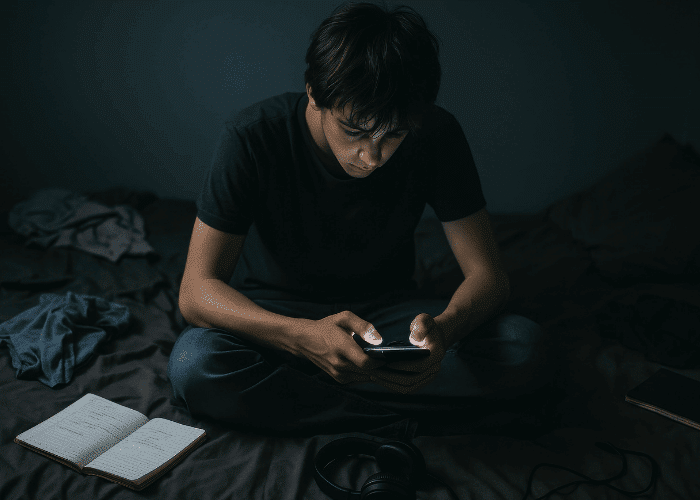
Doomscrolling can make a person highly aware of the negative events going on in the world. This can overload the nervous system with fear, even if the events aren’t happening near you. One way to protect teen mental health and social media impact may be to set intentional windows for looking at the news to avoid emotional overwhelm.
7. Normalizing Digital Detoxes:
Short digital detoxes – such as a day or a weekend – can help reset habits and restore balance. Some digital detox tips for adolescents to help get you started include:
- Having tech-free zones in the house
- Reducing the time spent each day on social media
- Taking a planned digital break for a day, weekend, or week
8. Protecting Privacy and Personal Information:
Understanding the individual app settings is important when considering how teens can set social media boundaries. Using privacy settings, limiting personal details, and remembering that posts can be permanent (even if they are later deleted) can help protect online safety and emotional well-being.
9. Involve Trusted Adults in Digital Wellness Conversations:
Digital wellness for adolescents can be supported by having open and honest conversations with trusted adults. Adults can play an important role here by helping teens understand how platforms work, how image feeds are carefully curated, and how social media algorithms shape and dictate the content they view. Also, teens who feel safe discussing online stress are usually more likely to seek help when they need it.
Mission Prep: Protecting Teen Well-Being in a Digital World

Creating and maintaining healthy boundaries can help protect adolescent mental health in a digital environment that’s been designed to capture their attention. However, if online stress begins affecting a teen’s mood, sleep, relationships, or school performance, professional support may help.
At Mission Prep, we help teens build healthy relationships with technology through education, coping strategies, and therapy that strengthens self-regulation.
If online stress is affecting your teen’s daily life, reach out to us to discover how we can support your family.
Frequently Asked Questions About Teen Mental Health and Social Media
It’s normal to have concerns about social media use, especially given how prevalent it is in adolescence. We’ve offered the following responses to some of the most frequently asked questions to provide as much clarity as possible.
What Are Healthy Social Media Habits for Teens?
Healthy social media habits for teens include setting time limits, protecting sleep, curating feeds, limiting distressing content, and practicing emotional awareness.
How Can Parents Help Teens Set Social Media Boundaries?
Parents can help their teens by modeling healthy habits online, discussing how platforms can influence mood, and agreeing upon realistic boundaries together.
When Does Social Media Use Become a Mental Health Concern?
If social media use causes sleep disruption, obsessive checking, mood changes, declining school performance, increased anxiety, or withdrawal from offline activities, your teen may benefit from seeking professional guidance.
References
- American Academy of Child & Adolescent Psychiatry (AACAP). (2023, October). Policy Statement on the Impact of Social Media on Youth Mental Health. https://www.aacap.org/AACAP/Policy_Statements/2023/Social_Media_Youth_Mental_Health.aspx
- Johns Hopkins Medicine. (2025, April 4). Social Media and Mental Health in Children and Teens. https://www.hopkinsmedicine.org/health/wellness-and-prevention/social-media-and-mental-health-in-children-and-teens
- American Psychological Association. (2018, April 19). Social comparison theory. APA Dictionary of Psychology. https://dictionary.apa.org/social-comparison-theory
- Weir, K. (2023, September 1). Social media brings benefits and risks to teens. Psychology can help identify a path forward. https://www.apa.org/monitor/2023/09/protecting-teens-on-social-media
- Cherry, K. (2025, September 24). How social comparison theory influences our views on ourselves. Verywell Mind. https://www.verywellmind.com/what-is-the-social-comparison-process-2795872
- Mental Health America. (2025, April 16). Social media, youth, and comparison. https://mhanational.org/resources/social-media-youth-and-comparison/
- Jacobson, R. (2025, August 27). Social media and Self-Doubt. Child Mind Institute. https://childmind.org/article/social-media-and-self-doubt/
- Nortje, A. (2025, November 10). Social Comparison Theory & 12 Real-Life examples. PositivePsychology.com. https://positivepsychology.com/social-comparison/
- Borman, A. (2023, December 29). The effect of social media on teens. American Society for the Positive Care of Children. American SPCC. https://americanspcc.org/the-effect-of-social-media-on-teens
- Masri-Zada, T., Martirosyan, S., Abdou, A., Barbar, R., Kades, S., Makki, H., Haley, G., & Agrawal, D. K. (2025). The Impact of Social Media & Technology on Child and Adolescent Mental Health. Journal of psychiatry and psychiatric disorders, 9(2), 111–130. https://pmc.ncbi.nlm.nih.gov/articles/PMC12165459/#S26
- Miller, C. (2025, April 1). Does social media use cause depression? Child Mind Institute. https://childmind.org/article/is-social-media-use-causing-depression/
- Ehmke, R. (2026, January 16). How using social media affects teenagers. Child Mind Institute. https://childmind.org/article/how-using-social-media-affects-teenagers/
- National Alliance on Mental Illness (NAMI). (2025, September 12). Social media use and impact on mental health. https://www.nami.org/advocacy/policy-priorities/stopping-harmful-practices/social-media-use-and-impact-on-mental-health/
- Hu, Y., Zhou, M., Shao, Y., Wei, J., Li, Z., Xu, S., Maguire, P., & Wang, D. (2021). The effects of social comparison and depressive mood on adolescent social decision-making. BMC Psychiatry, 21(1), 3. https://doi.org/10.1186/s12888-020-02928-y
- Gupta, M., & Sharma, A. (2021). Fear of missing out: A brief overview of origin, theoretical underpinnings and relationship with mental health. World Journal of Clinical Cases, 9(19), 4881–4889. https://doi.org/10.12998/wjcc.v9.i19.4881
- Hunt, M. G., Marx, R., Lipson, C., & Young, J. (2018). No more FOMO: Limiting social media decreases loneliness and depression. Journal of Social and Clinical Psychology, 37(10), 751–768. https://doi.org/10.1521/jscp.2018.37.10.751
- Silvani, M. I., Werder, R., & Perret, C. (2022). The influence of blue light on sleep, performance and wellbeing in young adults: A systematic review. Frontiers in Physiology, 13, 943108. https://doi.org/10.3389/fphys.2022.943108
- Gimbrone, C., Bates, L. M., Prins, S. J., & Keyes, K. M. (2021). The politics of depression: Diverging trends in internalizing symptoms among US adolescents by political beliefs. SSM – Mental Health, 2, 100043. https://doi.org/10.1016/j.ssmmh.2021.100043
- Institute for Healthcare Policy & Innovation. (2018, February 13). It’s not just you – politics is stressing out America’s youth. https://ihpi.umich.edu/news/its-not-just-you-politics-stressing-out-americas-youth
- Anxiety & Depression Association of America (ADAA): (2024, December 23). A Nation Exhausted: The Neuroscience of Why Americans are Tuning out Politics. https://adaa.org/learn-from-us/from-the-experts/blog-posts/consumer-professional/nation-exhausted-neuroscience-why