

The rise of social media use has become a major topic of discussion recently. With the overwhelming majority of teenagers active on social media in some form, understanding how social media exposure impacts adolescents is important for supporting teen mental health. Studies have consistently shown that being exposed to harmful content on social media poses a risk to youth mental health. Social media use has been linked to issues with self-esteem, body image, eating disorders, depression, anxiety, and suicidal ideation. However, it is also important to note that social media and technology use can be beneficial for some teens.1-2
This nuance matters when considering the new Virginia screen time law of 2025. Recent changes to the Virginia Consumer Data Protection Act have now taken effect, limiting social media use for under-16s to one hour per day per platform (with parental override). This article will explain the details of teen screen time restrictions in Virginia and the potential implications for teen mental health.3
Current Research Related to the Impact of Screen Time on Teen Mood
Understanding the current research on screen time and adolescent mental health provides important context for Virginia’s new law. There are several benefits associated with social media use in teens, including increased connection to a support system, the ability to learn new skills or information, and feelings of validation by those in a similar situation. Despite these findings, when research focuses on exposure to harmful content, it becomes clear that there are many negative implications for teen mental health.1,2
Part of the reason social media addiction has become a concern today is that the platforms are designed to encourage endless scrolling. For example, with the rise of artificial intelligence, many social media platforms rely on recommender systems to show teens specific content that is highly relevant to their interests, actions, and demographics. This poses a major threat to teen mental health because tailored content can include references to extreme viewpoints and controversial issues, such as misogyny, homophobia, racism, or eating disorder content.1,2
Sometimes this problem can be addressed through a platform’s content moderation process, but currently, there aren’t many laws and regulations in place to create a standard for content moderation. In many instances, this gap contributes to a link between social media, devices, and teen anxiety.1,2 Research also suggests that excessive screen time can interfere with sleep, attention, and digital device limits are increasingly seen as one way to address these concerns.
Understanding the New Virginia Law on Digital Use for Youth
Section 59.1-577.1 of the Code of Virginia went into effect on January 1, 2026, and it is known as the law on social media platforms, including responsibilities and prohibitions related to minors. Despite the headlines, there are several components to the Virginia digital well-being law that make it more complex than just setting a one-hour time limit on social media use for teens. The law applies specifically to anyone under 16 years of age in Virginia, but it also includes provisions intended for various social media platforms.3
For teens and parents in Virginia, this means social media platforms must use an age-screening mechanism to determine whether a user is a minor. Once the platform detects that the user is a minor, it will limit their screen time to one hour per day, per service or application, and give parents the right to increase or decrease the limit.3 This is one of several teen digital safety laws in Virginia aimed at protecting young users online.
Clarifying the Limits on Teen Device Use in Virginia
Based on the exact wording of the legislation, the one-hour time limit applies to each application or service per day. For instance, if a teen is using Instagram and TikTok, the law means that the teen is limited to one hour on each application per day. Knowing that there are many different social media platforms available today, the limits on teen device use in Virginia are not as strict as one might first think.3
Guidance For Parents On Teen Screen Time In Virginia
Parents play a key role in how this law affects their families. According to the Virginia screen time law 2025, parents have the ability to increase or decrease their child’s daily time limit.3
Ensuring open and clear communication between a parent and child is key to understanding how the law impacts the family. If you are open with your child about your expectations for social media exposure, they may feel more involved in the decision. This encourages family discussions about healthy technology habits for teens, including limiting exposure to harmful content.4
Mental Health Implications of Virginia Screen Time Rules
The goal of the Virginia screen time rules is to limit exposure to harmful social media for teens. However, there are a few implications of the law that should be discussed.
First, the law implies that one hour of social media use per platform per day is the limit for healthy screen time. However, research has shown that teen technology addiction can be identified by excessive social media use, which is measured by more than three hours per day. A 2019 study found that teens who used social media more than three hours a day may be more susceptible to developing depression or anxiety. However, the study found correlation, not causation. This means the specific one-hour teen social media limit isn’t directly supported by research.5
Another implication of the teen screen time restrictions in Virginia is that all social media exposure is detrimental to teens. However, according to research, screen time and adolescent mental health have a complex relationship. For example, there are specific factors that can moderate the potentially harmful outcomes associated with social media use, including the type of digital media exposure and engagement (active versus passive), quality of parent-child relationship, and excessive or problematic media use (PMU).4
If a teen is experiencing thoughts of self-harm or suicide, immediate support is available by calling or texting 988, the Suicide & Crisis Lifeline, or contacting a local emergency provider.
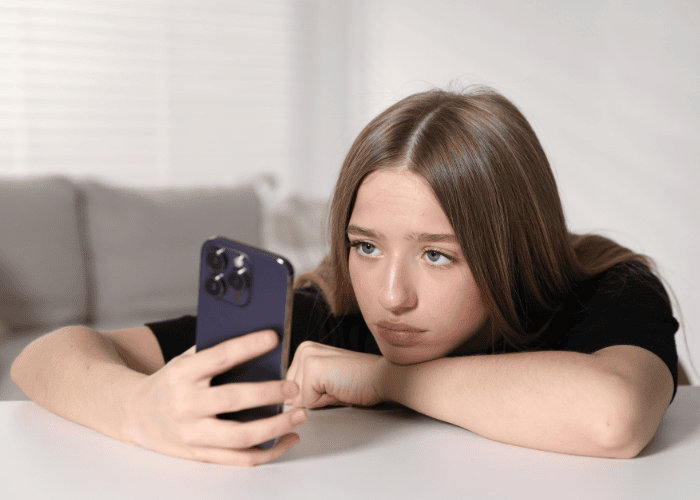
How Virginia’s Screen Time Law Affects Teens and Parents
The law requires social media platforms to include an age-screening process, but it does not state what the age-screening process entails. It simply specifies that the process be ‘reasonable’. Examples may include a prompt to enter a user’s age when signing up for a social media account or an interactive question that says ‘Are you under 16?’ on certain social media feeds. One impact of screen time laws on teens may be the added security measure required to sign up for a social media account. 3
Once the social media platform identifies that the user is a minor, your teen may find that there is a time limit default setting in the app and a parental consent process to update the time limit. By requiring parents to update the time limit, the law ensures that parents are aware of how long their children are exposed to social media daily. This shifts the control back to the parents, paving the way for discussions about digital well-being for teens.
Challenges to the Implementation of Screen Time Regulations
When it comes to implementing screen time restrictions and limiting social media use, there are some practical barriers that need to be considered. When looking at the new Virginia teen mental health legislation related to social media, a significant challenge is finding a way to enforce the time limit. As the law outlines, part of this responsibility will fall on the social media platform because the operator must use a reasonable age-screening tool to identify users under 16. However, there are ways to get around these tools. For instance, a teen may lie about their date of birth or provide false information when asked if they are under 16. Because of this, it will likely be difficult to enforce Virginia’s screen time regulations.6
Schools and screen time laws in Virginia may also intersect, as educators navigate how these regulations apply to devices used for learning. While the law targets social media platforms specifically, the broader conversation about digital well-being for teens is likely to continue in educational settings.
Mission Prep: Providing Mental Health Support for Teens in Virginia

If your child is managing a mental health condition in Virginia, Mission Prep is available to provide the appropriate treatment. Whether your teen is struggling with social media addiction or is beginning to see the adverse effects of too much screen time, there is a Mission Prep program tailored to your child’s needs. If you are ready to find out more about mental health care in Virginia for teens, contact us today. A member of our team can answer any questions you may have and recommend the appropriate level of care.
References
- Chhabra, J., Pilkington, V., Benakovic, R., Wilson, M. J., La Sala, L., & Seidler, Z. (2025). Social media and youth mental health: Scoping review of platform and policy recommendations. Journal of Medical Internet Research, 27, e72061. https://doi.org/10.2196/72061
- Masri-Zada, T., Martirosyan, S., Abdou, A., Barbar, R., Kades, S., Makki, H., & Agrawal, D. K. (2025). The impact of social media & technology on child and adolescent mental health. Journal of Psychiatry and Psychiatric Disorders, 9(2), 111. https://pmc.ncbi.nlm.nih.gov/articles/PMC12165459/
- Virginia General Assembly. (2025). § 59.1-577.1. Social media platforms: Responsibilities and prohibitions related to minors (Effective January 1, 2026). Code of Virginia. https://law.lis.virginia.gov/vacode/title59.1/chapter53/section59.1-577.1/
- Bolch, M. B., Moore, R. M., Robertson, G. C., Scafe, M. J., & Milkovich, L. M. (2025). Screens are not the enemy: Recommendations for developing healthy digital habits in youth. Missouri Medicine, 122(4), 297–302. https://pmc.ncbi.nlm.nih.gov/articles/PMC12331319/
- Riehm, K. E., Feder, K. A., Tormohlen, K. N., Crum, R. M., Young, A. S., Green, K. M., & Mojtabai, R. (2019). Associations between time spent using social media and internalizing and externalizing problems among US youth. JAMA Psychiatry, 76(12), 1266–1273. https://doi.org/10.1001/jamapsychiatry.2019.2325
- Firmansyah, D., & Sujana, A. (2026). Policy analysis of age restrictions on social media use for children as a social protection measure. Journal of Societas Beneficium, 1(1), 46–58. https://ejournal.grafindoscience.com/jsb