Key Takeaways
- The 5 most effective social skills activities for ADHD students are role-playing real-life scenarios, cooperative board and card games, turn-taking conversation circles, emotion charades, and team-based problem-solving challenges, with each activity targeting a different social skill in a low-pressure setting.
- ADHD students often find it hard to manage impulses, wait their turn, and read facial expressions or tone of voice, which makes friendships, group work, and family interactions feel stressful or confusing without consistent practice.
- Short, structured sessions of 5 to 30 minutes work best because they match ADHD attention spans, and pairing each activity with quick, specific feedback helps lessons carry over into school, home, and peer settings.
- Parents, teachers, and counselors can lead these activities at home or in the classroom, but if a teen still struggles with peer rejection, isolation, or co-occurring anxiety, structured adolescent therapy is often the next step.
- Mission Prep supports teens aged 12 to 17 with adolescent-only residential, outpatient, and virtual programs that pair CBT, DBT, EMDR, and TMS with weekly family therapy and academic coordination to build lasting social and emotional skills.
What Do Social Skills Activities Look Like for ADHD Students?
Social skills activities for ADHD students work best when they are brief, hands-on, and repeated often, since teens with attention challenges absorb lessons through practice rather than lectures.
Mission Prep weaves these activities into structured adolescent therapy for ages 12 to 17, blending role-play, group work, and weekly family sessions to help teens manage impulses, read social cues, and build steady friendships.
Outside clinical care, parents and teachers can also support social growth at home or in the classroom using simple, evidence-informed exercises. Role-playing scenarios, cooperative games, conversation circles, emotion charades, and team challenges each target a different piece of the social puzzle and can be tailored to different ages and energy levels.
This guide breaks down how each activity works, the skills it builds, and how to run it well with ADHD learners.
5 Social Skills Activities That Work for ADHD Students
1. Role-Playing Social Scenarios
Role-playing gives ADHD students a safe place to rehearse real moments before they happen. A parent or teacher sets up a scene, such as joining a group at lunch or asking a teacher for help, then takes turns acting out responses.
This activity works because it removes the social pressure of getting it right in front of peers. Keep scenes short, around 2 to 3 minutes, since long role-plays often lose a student with ADHD partway through.
Switch roles often so the student practices both sides of the interaction, like the person asking and the person responding. End each round with a quick chat about what felt natural and what could be said differently next time.
For older teens, try harder scenarios, such as handling teasing, disagreeing politely, or apologizing after a mistake. These social scripts give ADHD students a mental playbook to pull from later when emotions run high in real life.
Add a small prop or two, like a pretend phone or a backpack, to make the scene feel real. Visual and physical cues help ADHD students stay focused during the round and remember the lesson afterward.

2. Cooperative Board Games & Card Games
Games that require teamwork rather than head-to-head competition are great for teaching patience, turn-taking, and group communication. Try titles like Forbidden Island, Pandemic, or Outfoxed, where all players win or lose together. ADHD students often feel less anxious in cooperative settings because the focus is on group success.
Set clear ground rules before play begins, such as one person speaking at a time and waiting for your turn without coaching others. These boundaries help students with impulsivity practice self-control in a fun setting.
Choose shorter games, around 20 to 30 minutes, to match attention spans and end on a positive note. After the game, ask reflective questions like, “What helped the team?” or “What felt frustrating during play?”
This builds emotional awareness and gives the student language to describe social challenges in other parts of life. Over time, the same words come up in school and family settings, making the lessons stick.
For younger students, simple card games like Uno with cooperative house rules work well, too. The point is shared success, so wins feel earned by the group rather than one player.
3. Turn-Taking Conversation Circles
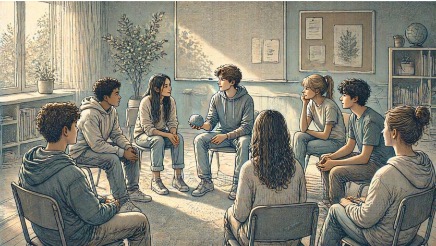
Conversation circles are a structured talking activity where each person gets the same amount of time to speak while others listen. Pass a small object, like a soft ball or a talking stick, around the group. Only the person holding it can speak.
This visual cue helps ADHD students manage impulses and wait their turn. Start with a low-pressure topic, such as a favorite meal, a weekend plan, or a movie they liked recently.
As the group warms up, move toward feelings-based prompts like a moment they felt proud, or a time something at school felt unfair. Keep each turn brief, around 30 to 60 seconds, so attention stays high during the whole circle.
Listening is the other half of this skill. Ask students to repeat back one thing the previous speaker said before they begin their own turn. This trains active listening, a skill many ADHD students find hard but can build with regular practice.
Family dinner is a natural time to try this at home, with each person sharing one good and one tough part of their day. The routine becomes a daily social skills lesson without feeling like training.
4. Emotion Charades & Feelings Identification Games
Many ADHD students miss facial expressions and tone of voice during fast social exchanges. Emotion charades helps them slow down and read body language carefully.
Write feelings on small cards, including basics like happy or angry, along with subtler ones like embarrassed, nervous, or proud. Players act out the emotion without speaking, while others guess what is being shown.
For variety, try a feelings matching game using printed faces or short video clips paired with emotion labels. This works well for younger teens who are still building emotional vocabulary.
The more words a student has for their feelings, the better they can handle social conflict without acting out. Pair this with a quick discussion of when each emotion shows up in real life, like at school or with siblings at home.
Mix in body language without faces, too, such as crossed arms or slumped shoulders, to teach the full range of social cues. Reading whole-body signals matters as much as reading faces during everyday peer interactions.
5. Team-Based Problem-Solving Challenges
Team challenges blend physical movement with social practice, which suits the energy of many ADHD students. Try simple builds like marshmallow and spaghetti towers, a paper airplane contest with a target, or escape-room style puzzles done in pairs.
These tasks require teens to share ideas, compromise, and divide group roles. Set a clear goal and a time limit of 10 to 15 minutes to keep focus tight.
Assign rotating roles like leader, recorder, and builder so each student practices different positions in a group. Movement and hands-on work also help ADHD students stay regulated, which makes calm communication easier during the task.
After the activity, talk briefly about what each person did well as a teammate. Direct, specific feedback like “you listened when Alex suggested changing the base” lands better than general praise for ADHD learners.
Outdoor versions work well too, like a simple scavenger hunt where teams must agree on a search route before starting. Adding fresh air and movement keeps energy levels up and lowers the social pressure that often builds up in indoor groups.
Top 5 Social Skills Activities for ADHD Students: Summary Table
| Activity | Skills Built | Best Age Range | Time Needed |
| Role-Playing Scenarios | Social scripts, perspective-taking | 8 to 17 | 5 to 15 min |
| Cooperative Board Games | Turn-taking, teamwork, and patience | 8 to 17 | 20 to 30 min |
| Conversation Circles | Active listening, impulse control | 10 to 17 | 10 to 20 min |
| Emotion Charades | Reading body language, emotional vocabulary | 8 to 15 | 10 to 20 min |
| Team Problem-Solving | Cooperation, compromise, and role flexibility | 10 to 17 | 15 to 30 min |
How Does Mission Prep Support Teens With ADHD?

These 5 activities give parents, teachers, and therapists practical tools to help ADHD students build social confidence at their own pace. Role-play, cooperative games, conversation circles, emotion charades, and team challenges each target a different piece of the social puzzle, from impulse control to reading body language. Done in short, regular sessions, they help students with ADHD turn awkward moments into chances to grow.
At Mission Prep, we offer adolescent-only mental health programs for teens 12 to 17 whose social struggles tie into anxiety, depression, trauma, or mood challenges. Our therapists pair CBT, DBT, EMDR, and TMS with weekly family therapy and academic coordination inside small, licensed home-like settings across California, Minnesota, and Virginia. Contact us to learn how our residential, outpatient, and virtual programs support social and emotional growth while helping students stay on track academically.
Frequently Asked Questions (FAQs)
At what age should social skills training start for kids with ADHD?
Social skills training can begin as early as preschool, but most therapists recommend structured practice by ages 7 to 10. Early intervention helps children build habits before peer rejection patterns form. Teens still benefit greatly, since adolescence brings new social demands, such as dating and group identity.
Can social skills activities replace therapy for ADHD?
Activities at home or school help, but they do not replace clinical care for moderate to severe ADHD or co-occurring conditions like anxiety and depression. A licensed therapist can spot underlying issues, adjust strategies, and use methods like CBT or DBT that go deeper than classroom games alone.
How long does it take to see improvement in social skills?
Most parents and teachers notice small changes within 4 to 8 weeks of consistent practice. Bigger gains, like making and keeping friends, often take several months. Progress depends on the child’s age, the severity of symptoms, and how often the activities happen in daily life.
What if my teen refuses to do social skills activities?
Resistance is common, especially in older teens who feel singled out. Make activities low-pressure by inviting siblings or friends to join, or try them during regular family time, like dinner. If refusal persists, a teen-focused therapist can build motivation through trust before adding skill-building.
Why choose Mission Prep for teens with ADHD and social challenges?
Mission Prep serves only teens aged 12 to 17, so our programs align with their stage of life. We pair evidence-based therapies such as CBT, DBT, EMDR, and TMS with academic support, weekly family therapy, and small, home-like settings in California, Minnesota, and Virginia to support steady social growth.