
For so many of us, the arts feel like a necessity. If you’re someone who listens to a lot of music, gets lost in a good book, or has a calendar full of live events, you’ll know the feeling.
But, often, people think that creativity is only reserved for people with natural talent, such as our favorite artists or musicians. So it might be hard to imagine that you also have access to the benefits of the creative world. Instead, you might see it as out of reach or simply, “not for you.” But that doesn’t have to be the case. The arts can boost well-being regardless of your background or talents.
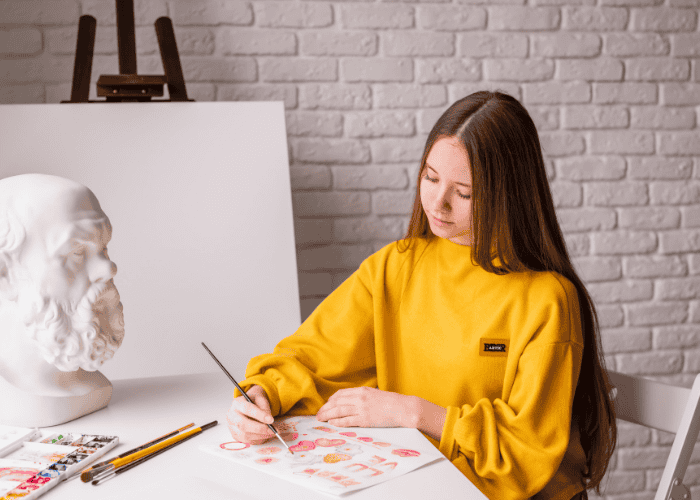
Being creative doesn’t mean making major life shifts or giving up your career to pursue the arts – creativity can happen in small, everyday ways. Taking up a new hobby, learning an instrument, or simply picking up a pencil and paper can make a difference.
Remember: You don’t have to be a trailblazing genius. In fact, you don’t even have to be good at the art form you choose. Creative expression is just a great way to have fun, pass the time, and – even more importantly – benefit your mental well-being.
So let’s get into it. Here’s a little more on the well-researched link between creativity and mental health, followed by five ways that the arts can boost well-being.
Understanding the Link Between Creativity and Mental Health
It might sound cliché, but creativity can mean turning personal pain into something beautiful. Let’s turn to some examples of how to really help illustrate this…
David Bowie’s Blackstar is an artistic expression of his mortality during terminal illness. Back to Black by Amy Winehouse reflects her pain during a tumultuous relationship. An masterpieces created by Vincent Van Gogh were borne from struggles with mental health.
These may be examples on a grand scale, but the principle of creativity remains the same for everyone. It’s a means to process our thoughts and emotions, but sometimes, it can produce something that, in turn, helps others relate and process their own pain.
Let’s focus on what the creative process itself can do for our mental health. Research shows that engaging in creative activity helps reduce stress, improve mood, and support long-term emotional resilience.1
But if you’re prone to worrying often, or if you’re an overthinker, then you’ll know how hard it can feel to switch off. Yet, during a creative activity, you may enter what’s called a “flow state”. This is a feeling of your mind being fully immersed in the “doing”; no wandering worries, no racing thoughts – just your brain engaging with your hobby of choice.2 For example, it’s when you’re writing, and the words start flowing, or when you’re playing the guitar, and you become lost in a solo. In a nutshell, it’s why creative activities can feel calming even if you’re not trying to relax.
Simply put, creative hobbies are confirmed by research as a good way to relax.1 So it’s a safe outlet for young people navigating school, social pressures, and stress. It doesn’t require perfection, and there’s no “right” way to do it.
5 Ways the Arts Can Boost Well-Being
To help you fully understand how the arts can benefit your mental health, here are five ways that the arts can boost well-being.
1. Creative Expression Can Help You Process Emotions
Too often, emotions and complex feelings get “bottled up”. For various reasons, there might be a reluctance to seek support or offload to someone else. For example, a teen might worry about being judged or experiencing stigma.
Fortunately, engaging in creative hobbies means that there’s somewhere else for complex emotions to go. So it’s easy to see why journaling and expressive writing have proven benefits for untangling racing thoughts and processing difficult emotions. 7
Creative outlets can be especially helpful when emotions feel overwhelming or confusing. You might not know why you feel anxious or frustrated, but expressing it creatively can help you get there. For instance, free writing is a great way to let thoughts flow, allowing you to detect recurring themes or patterns.
This is also why art therapy for mental health is widely used in clinical and school settings.³ It provides a non-verbal way to explore feelings, which can feel safer and less intimidating than talking, especially for younger people who might be more prone to shyness.
2. Creativity Can Reduce Stress and Anxiety
The flow state we discussed earlier can do a lot for calming our nerves. What’s more, research confirms that engaging in creative activities like painting, cooking, or playing music actually calms the body’s stress response. Hobbies like this reduce cortisol, sometimes referred to as the “stress hormone”.4
What’s more, creativity doesn’t just work in a mental sense; it also has physical effects on the body that can help us relax. So not only are we getting relief from the hum of our internal worries, but the act of losing ourselves in a creative pursuit can also slow breathing and release muscle tension.8
Creativity doesn’t have to be a big commitment either. Even short bursts of activity like writing, drawing, or playing music after a stressful day can interrupt anxious thought patterns.9
3. The Arts Can Boost Mood and Positive Emotions
When we create something, even as simple as a home-cooked meal, we tend to feel good – like we’ve accomplished something. This sense of accomplishment can go a long way when motivation is low or when we’re feeling stuck.
In other words, a major benefit of creativity is that it’s rewarding; it results in an increased release of dopamine in the brain, sometimes referred to as the “happy chemical”.10
So arts and emotional health are closely connected in that pouring ourselves into an activity can simply make us feel good. Creative activities can:
- Provide a sense of purpose
- Create moments of enjoyment
- Offer small wins that build momentum
4. Creativity Can Build Self-Identity and Confidence
Growing up, the majority of us spend years in systems that may require us to fit into certain social groups, adhere to set rules, and behave within certain expectations. While these systems can serve a purpose, teaching us discipline and routine, they can also feel restrictive. Simply put, sometimes they can feel like they don’t embrace individual personalities and expression.
Creative hobbies can be a respite, as they allow us to try things out, experiment, and find out things about ourselves in ways that might not come about through regular day-to-day life. Whether this is through writing, music, or fashion. After all, the arts can be a valuable means of identity for a lot of us. It helps us define ourselves and find other people with similar interests. For instance, maybe through experimenting, you might find that you identify with the “metalheads”, the “bookworms”, the “foodies” – the list goes on.
What’s more, confidence often grows as a result of finding a creative aspect of our identity. What might be a half hour a day playing the guitar could, with practice, become the ability to play chords effortlessly, allowing you to build a repertoire of songs. This confidence can carry over into life broadly – such as in school, work, or relationships.
5. Creative Activities Can Encourage Mindfulness and Presence
What is mindfulness? It’s the ability to stay present in the moment. Mindfulness is widely used in mental health support because it helps regulate emotions and reduce anxiety.⁶
But too often we can get caught up mulling over past regrets or worrying about what’s ahead of us, removing us from the here and now. Plus, it can feel particularly hard to switch off in the current digital age where constant notifications and advertising can further distract us from the present.
Returning to the flow state, you might be able to see how creativity can be an excellent counter to an overactive mind. Many creative activities naturally promote mindfulness, which is another key reason why encouraging mental wellness through art is so effective.
Creative activities offer an accessible way to experience mindfulness, especially for people who find more traditional approaches (such as meditation) difficult or frustrating.
Examples of mindful creative activities include:
- Drawing
- Playing an instrument
- Writing freely without editing yourself
- Building or crafting something with your hands, such as crocheting, knitting, or woodwork
How to Start Using Creativity for Your Mental Health
Remember, you don’t have to be a prodigy or a genius to use creativity to boost your well-being. A big barrier to creativity is the all too common belief that someone isn’t creative enough to make it work for them. But, creativity is just a means expression, it’s not a fixed trait. So you can use it in any way that works for you. Just aim to keep it simple and low-pressure at the start. The goal isn’t to perform, just explore.
Here are some practical ways to begin:
- Set aside 15–30 minutes a few times a week for a creative activity of your choice
- Try a few different things out until something feels enjoyable
- Focus on how it feels, not how it turns out. The goal is to enjoy the process, not necessarily the outcome
- Use creativity as a way to check in with yourself during stressful moments
- Pair creativity with something else relaxing. Like if you’re crafting something, put your favorite album or audiobook on in the background.
It can also help to remove expectations. You don’t need to share what you create, and it doesn’t need to be “good.” The benefits come from the process itself.
Mission Prep: Helping You Express More and Stress Less
The experienced team at Mission Prep understands that life isn’t always easy for teens and young adults navigating a fast-paced, often overwhelming world. The good news is that creativity provides something valuable: a space to slow down, reflect, and reconnect with yourself.
Sometimes, when life feels like too much, it can feel really challenging to take time to yourself and explore creative hobbies. Fortunately, Mission Prep is on hand to help you tap into this perhaps underaccessed side of yourself. We do so by offering a range of therapy options – including art therapy – as well as other holistic approaches and lifestyle changes designed to fit your needs.
Mission Prep also offers telehealth services, so if you’re unable to reach us in person, we can help you remotely at a time that suits you.
If you’re ready to explore Mission Prep’s treatment options or if you have any questions about how we can help, our team is here 24/7 to assist you. Reach out to us today or email info@missionprephealthcare.com.
References
- Stuckey, H. L., & Nobel, J. (2010). The connection between art, healing, and public health. American Journal of Public Health, 100(2), 254–263. https://doi.org/10.2105/AJPH.2008.156497
- Csikszentmihalyi, M. (1990). Flow: The psychology of optimal experience. Harper & Row. https://doi.org/10.1037/0003-066X.56.3.205
- American Art Therapy Association. (2021). About art therapy. https://arttherapy.org/about-art-therapy/
- Kaimal, G., Ray, K., & Muniz, J. (2016). Reduction of cortisol levels and participants’ responses following art making. Art Therapy, 33(2), 74–80. https://doi.org/10.1080/07421656.2016.1166832
- Ellamil, M., Dobson, C., Beeman, M., & Christoff, K. (2012). Evaluative and generative modes of thought during creative cognition. NeuroImage, 59(2), 1783–1794. https://doi.org/10.1016/j.neuroimage.2011.08.008
- Garland, E. L., Farb, N. A., Goldin, P. R., & Fredrickson, B. L. (2015). Mindfulness broadens awareness and builds eudaimonic meaning. Current Opinion in Psychology, 3, 10–15. https://doi.org/10.1016/j.copsyc.2015.01.012
- Pennebaker, J. W., & Chung, C. K. (2011). Expressive writing: Connections to physical and mental health. In The Oxford handbook of health psychology. https://doi.org/10.1093/oxfordhb/9780195342819.013.0018
- Motlagh, A., Amini, M., & Malekirad, A. A. (2023). The effect of art-based interventions on physiological and psychological outcomes: A systematic review. Frontiers in Psychology, 14, 1123456. https://doi.org/10.3389/fpsyg.2023.1123456
- Kaimal, G., Ray, K., & Muniz, J. (2016). Reduction of cortisol levels and participants’ responses following art making. Art Therapy, 33(2), 74–80. https://doi.org/10.1080/07421656.2016.1166832
- Salimpoor, V. N., Benovoy, M., Larcher, K., Dagher, A., & Zatorre, R. J. (2011). Anatomically distinct dopamine release during anticipation and experience of peak emotion to music. Nature Neuroscience, 14(2), 257–262. https://doi.org/10.1038/nn.2726