


Key Takeaways
- The five signs of OCD in teen girls are intrusive thoughts, repetitive rituals, perfectionism with reassurance seeking, avoidance of triggers, and emotional withdrawal. Many girls hide these patterns well, performing mental rituals quietly or framing rigid behaviors as personal preferences.
- The hardest part is that these signs look like ordinary teen behavior. Avoidance gets read as shyness, perfectionism looks like high standards, and reassurance seeking sounds like normal anxiety, so families often wait months before realizing something larger is in play.
- Mission Prep treats teen OCD inside teen-only programs for ages 12 to 17, using CBT with Exposure and Response Prevention as the core approach alongside DBT, EMDR, and TMS. Care is delivered in residential, outpatient, and virtual formats so families can match the level of support to the severity of symptoms.
- Mental rituals are the easiest signs to miss. Counting, praying in fixed sequences, and replaying past conversations word by word can consume two or more hours a day with nothing visible on the outside.
- Mission Prep runs adolescent OCD care in licensed home-like settings in Rancho Palos Verdes, Rolling Hills Estates, and Waterford, with weekly family therapy and academic coordination built into every program.
The Quiet Patterns Parents Often Miss
The five signs of OCD in teen girls are intrusive thoughts that keep returning, repetitive rituals performed to ease anxiety, perfectionism paired with constant reassurance seeking, avoidance of people or places that trigger fear, and emotional withdrawal as the daily effort wears her down. Each sign looks slightly different in adolescent girls because many of the rituals are mental, the perfectionism gets framed as ambition, and the avoidance is often mistaken for a moody phase. Knowing which behaviors to watch for, and how they cluster, is what helps parents tell OCD apart from typical teen stress.
OCD in adolescent girls often starts quietly, somewhere between ages 10 and 14, with symptoms that can shift content from month to month as school pressure, friendships, and hormonal changes shape what she fixates on. The sections below walk through each of the five signs with practical examples, the settings where they tend to appear, and the small details that separate them from normal teen behavior.
5 Signs of OCD in Teen Girls
1. Intrusive Thoughts and Excessive Worry
Intrusive thoughts are unwanted images, fears, or ideas that pop into a teen’s mind and feel impossible to push away. A teen girl with OCD may have repeated fears about contamination, harm coming to her family, acting inappropriately in public, or doing something morally wrong. These thoughts feel real and threatening, even when she knows they are unlikely.
Common themes include fears about germs, illness, death, violent or sexual images, religious or moral worry, and fears of accidentally hurting someone. The thoughts often feel out of character, which adds to her shame and confusion. Many girls worry they are bad people for having these thoughts in the first place, even though intrusive thoughts are a symptom of the condition rather than a reflection of who they are.
She might ask the same worry-based questions repeatedly, such as “Did I lock the door?” or “What if I hurt someone by accident?” Unlike normal teen worries that come and go, intrusive thoughts in OCD are persistent and cause real distress. Parents often notice their daughter seems stuck on a particular fear for days or weeks, returning to it despite repeated reassurance.
The thoughts can also shift in content over time. A teen might fixate on contamination one month and harm-related fears the next. Stressful school periods, social conflicts, and hormonal changes can intensify both the frequency and intensity of intrusive thoughts.
2. Repetitive Behaviors and Rituals
Compulsions are repeated actions a teen feels she must perform to reduce the anxiety created by intrusive thoughts. In teen girls, these can include hand washing, checking locks, organizing items in a specific order, tapping objects, or repeating phrases silently. Some rituals are visible, but many are mental, such as counting, praying in a fixed sequence, or reviewing past conversations word by word.
A common pattern is rewriting homework multiple times until it feels right, taking far longer to complete tasks than her peers. The need to perform rituals can interfere with sleep, school attendance, and time with friends. Some teens spend two or more hours each day on rituals alone, often without their parents realizing how much time they take up.
Bedtime routines often become especially long, with rigid sequences that must happen in a specific order. If interrupted, she may feel compelled to restart the entire sequence. Morning routines can also stretch out, causing her to be late for school regularly.
Many girls develop rituals around symmetry, lining up shoes, books, or toiletries in exact patterns. Others touch certain objects a set number of times before leaving a room. When parents try to disrupt these behaviors, the teen may become tearful, panicked, or angry, since the rituals feel like the only way to keep her fears in check.
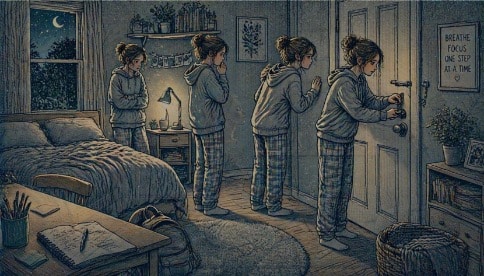
3. Perfectionism and Reassurance Seeking
Perfectionism in OCD goes beyond wanting good grades. A teen girl may rewrite the same paragraph for hours, fix and refix her hair, or refuse to submit work unless it feels exactly right. The drive is not about achievement; it is about easing internal anxiety. The work feels wrong on a gut level until each small detail matches an internal standard she cannot fully describe.
Reassurance seeking is closely tied to this sign. She may repeatedly ask her parents whether she said something wrong, whether her outfit looks fine, or whether a small mistake could lead to harm. Even after multiple confirmations, the doubt returns, and the question gets asked again, sometimes in slightly different words to test the answer.
This pattern can be exhausting for the whole family. Parents may feel they are walking on eggshells, never able to fully reassure their daughter despite their best efforts. Teachers might notice she stays after class to confirm she understood the assignment correctly, or repeatedly emails to clarify minor instructions.
Social media can intensify this sign as well. A teen girl with OCD may delete and repost photos, edit captions for an hour, or check messages obsessively for signs that something she said was misread. The need for certainty drives the cycle, and certainty rarely arrives.
4. Avoidance of Triggers
Avoidance shows up when a teen starts steering clear of people, places, or situations that activate her obsessions. She might avoid public restrooms over contamination fears, refuse to use certain numbers or colors, or skip social events where she feels she could lose control of her thoughts or behavior.
Avoidance is often mistaken for shyness, social anxiety, or laziness. Parents may see her withdraw from activities she once enjoyed without understanding the obsessive fear driving the change. She may quit a sport, drop a favorite class, or stop visiting certain rooms in the house without offering a clear reason.
Food avoidance is another pattern in some girls, especially when fears center on contamination or choking. She may refuse meals prepared by certain people, avoid restaurants, or stick to a narrow list of safe foods. This can sometimes be confused with another mental health concern, so careful evaluation is important.
Over time, avoidance can shrink her world. School subjects, hobbies, and friendships may all be affected as she works harder to dodge anything that could spark an obsession. Some girls begin avoiding entire categories of media, songs, or words because of associations they have built up in their minds.
5. Emotional Distress and Withdrawal
OCD takes a heavy emotional toll on teen girls. Many feel ashamed of their thoughts, exhausted by their rituals, and isolated from peers who do not understand. This can lead to irritability, mood swings, tearfulness, and pulling away from family conversations. The internal effort to manage symptoms is invisible but constant.
Some teens develop secondary depression or social anxiety as the condition progresses. A previously social, engaged daughter may begin spending hours alone in her room, declining invitations, or losing interest in hobbies she once loved. Grades may drop even though she is studying as much as before, because rituals eat into her actual learning time.
Sleep disturbances, low energy, and emotional flatness are also common as the burden of managing the condition alone wears her down over time. Some girls report feeling numb, disconnected, or like they are watching their lives from a distance, especially during periods of intense compulsive behavior.
Anger and shutdowns can spike when family members try to interrupt rituals or push her to face situations she avoids. These outbursts are not defiance; they are the surface signs of an internal system that feels overloaded. Watching for this kind of distress alongside the other four signs gives parents a fuller picture of what their daughter may be facing.

5 Signs of OCD in Teen Girls: At-a-Glance Summary Table
| Sign | What It Looks Like | Why It Matters |
| Intrusive Thoughts | Persistent, unwanted fears or images | Drives compulsions and ongoing emotional distress |
| Repetitive Rituals | Visible or mental routines done to ease anxiety | Disrupts sleep, school, and daily routines |
| Perfectionism & Reassurance | Redoing tasks, asking the same questions | Slows daily functioning and feeds doubt |
| Avoidance | Skipping triggers, places, or situations | Often mistaken for shyness or low motivation |
| Emotional Distress | Withdrawal, shame, irritability | Can lead to secondary depression or isolation |
How Mission Prep Supports Teen Girls Through OCD Recovery

Recognizing the five signs together, rather than in isolation, is what gives parents a real starting point. A teen girl may show one or two behaviors without having OCD, but persistent intrusive thoughts, rituals, perfectionism, avoidance, and emotional withdrawal lasting weeks point to a need for proper assessment and a structured plan for recovery.
Mission Prep treats adolescent OCD inside teen-only programs for ages 12 to 17, using CBT with Exposure and Response Prevention as the lead therapy and adding DBT, EMDR, and TMS where they fit each teen’s needs. Residential, outpatient, and virtual options run out of licensed home-like settings in California, Minnesota, and Virginia, with weekly family therapy and academic coordination so daily life keeps moving forward while she works on recovery.
Visit Mission Prep to start your daughter’s OCD recovery journey with teen-only residential, outpatient, and virtual care.
Frequently Asked Questions (FAQs)
At what age does OCD usually start in girls?
OCD often begins in girls between ages 10 and 14, though earlier and later onsets are common. Symptoms can appear gradually or suddenly, especially around hormonal changes during puberty. Early signs may be subtle, like quiet rituals or repeated questions, before becoming more disruptive to school and family life.
Can teen girls outgrow OCD without treatment?
OCD rarely resolves on its own. Without treatment, symptoms often shift form, become more rigid, or expand into new fears over time. With early support through therapies like CBT and ERP, many teens learn to manage symptoms effectively and reduce their impact on school, friendships, and family life.
How is OCD different from regular anxiety in teen girls?
General anxiety involves broad worry about real-life concerns. OCD centers on specific intrusive thoughts paired with compulsions performed to ease distress. Both can overlap, but OCD ritual patterns are more rigid, time-consuming, and tied to feared consequences. Distinguishing between them is necessary to choose the right therapy approach.
Can OCD in teens be treated without medication?
Yes, many teens manage OCD primarily through therapy. CBT with Exposure and Response Prevention is considered the leading approach, and DBT, EMDR, and TMS offer additional non-medication paths. Family therapy further supports recovery. Treatment plans are built around each teen’s needs, and many achieve strong results without medication.
What makes Mission Prep different for teen OCD treatment?
At Mission Prep, we serve only adolescents aged 12 to 17, with licensed home-like settings in California, Minnesota, and Virginia. Our team uses CBT, DBT, EMDR, and TMS, alongside academic support and weekly family therapy. We offer residential, outpatient, and virtual programs so families can choose the level of care that best fits their daughter’s needs.